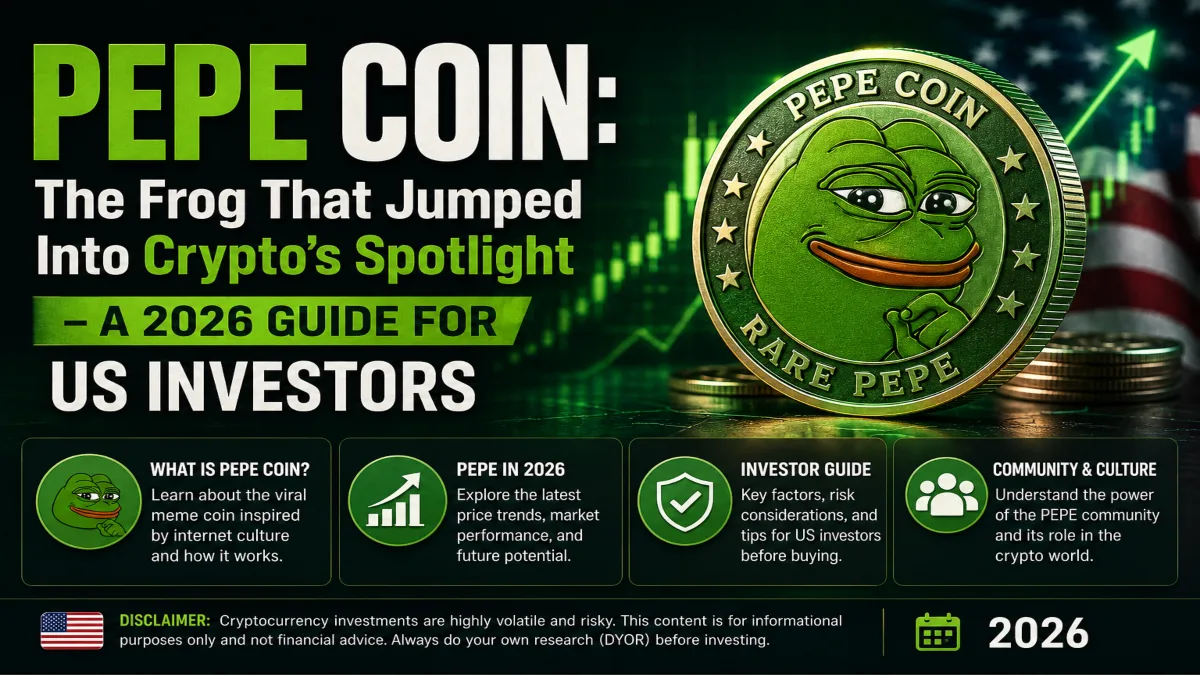
The world of cryptocurrency is known for its serious technology and complex financial instruments. However, sometimes a digital asset captures the market’s attention not because of its utility, but because of its cultural moment and viral appeal. Pepe Coin (PEPE), a meme coin featuring the infamous “Pepe the Frog,” has done exactly that since its explosive launch in 2023.
As of mid-2026, PEPE has cemented itself as the third-largest meme coin by market capitalization, and its journey offers a fascinating case study of internet culture colliding with high-stakes finance. For U.S. investors and collectors, understanding this digital token is about learning how to navigate one of the most volatile, exciting, and risky corners of the market.
The Birth of Pepe: A Fair Launch Frenzy
Pepe Coin is an ERC-20 token built on the Ethereum blockchain, officially launched in mid-April 2023. Unlike many traditional cryptocurrency launches with venture capital backing and pre-sales, the creators of PEPE opted for a model often called a “fair launch.” It had no pre-mine, no team allocations, and no private investor rounds, meaning anyone could buy the token directly from the smart contract from day one.
Inspired by the “Pepe the Frog” character originally created by artist Matt Furie in 2005, the project leaned heavily into internet meme culture. This approach paid off spectacularly. PEPE’s market capitalization soared past $420 million in just weeks, and it hit a staggering $1.5 billion peak in early May 2023, demonstrating the immense power of social media-driven hype.
Tokenomics: The Numbers Behind the Frog
Understanding the basic numbers of a meme coin is crucial for any potential buyer. The maximum total supply of PEPE is approximately 420.69 trillion tokens, a massive number that reflects its pure meme-driven nature. At launch, the circulating supply was about 420 trillion tokens. However, a significant initial burn event soon after removed a staggering 210 trillion tokens (50% of the total initial supply) from circulation, followed by another burn of 6.9 trillion tokens in December 2024.
These burns are designed to create artificial scarcity, which can potentially support the token’s price if demand remains high or grows. However, it’s important to note that the burn mechanism is generally manual and community-initiated, not an automatic, protocol-level feature like Bitcoin’s halving.
As of June 2026, PEPE’s live price hovers around $0.0000028 to $0.0000034, with a market capitalization between $1.2 billion and $1.5 billion. Its 24-hour trading volume frequently ranges from $150 million to over $200 million, indicating intense speculative activity.
Market Performance and Key Catalysts for 2026
The price of PEPE has been nothing short of a roller coaster. After its all-time high in May 2023, it retraced significantly, only to see renewed momentum in early 2026, leading the charge in a broader meme coin rally that added billions to the sector’s market cap.
Looking ahead to the rest of 2026, analysts are watching two major catalysts closely.
First, there is the potential for a spot PEPE exchange-traded fund (ETF) in the U.S. Asset manager Canary Capital filed an S-1 registration statement with the SEC for a spot PEPE ETF on April 8, 2026. An approval would give traditional investors regulated exposure to the meme coin without needing to hold the token directly, marking a significant step toward mainstream adoption.
The second catalyst is Bitcoin’s performance. Many market observers believe that a major altcoin rotation, where capital flows from Bitcoin into smaller tokens like PEPE, typically requires Bitcoin to clear key resistance levels, such as $98,000. If this happens, PEPE could see significant upside.
Price predictions for 2026 vary wildly, reflecting the asset’s speculative nature. A moderate “base case” forecast suggests PEPE could reach $0.0000060 by year-end, roughly 75% above its price in late May 2026, while a more optimistic “bull case” puts it at $0.0000120. Other predictions are even more aggressive, with some forecasting a maximum level of $0.000025 in 2026.
The Community: The Engine of Hype
Pepe Coin’s value proposition is almost entirely dependent on its community. It has a highly active and vocal base on platforms like Twitter (X), Reddit, and Discord. In fact, social media sentiment around PEPE is often a key driver of its price movements. According to recent data, the social activity surrounding the token remains extremely high, with many short-term traders using its volatility for aggressive trading opportunities. In the meme coin world, narrative strength is often more important than technical fundamentals, and PEPE continues to dominate conversations across crypto communities.
Pepe vs. Dogecoin vs. Shiba Inu
For context, it helps to compare PEPE with its two larger rivals: Dogecoin (DOGE) and Shiba Inu (SHIB).
- Dogecoin (DOGE) is the original meme coin, launched in 2013. It operates on its own proof-of-work blockchain and has the most real-world adoption for payments, with endorsements from figures like Elon Musk.
- Shiba Inu (SHIB), launched in 2020, is also an ERC-20 token on Ethereum but has worked to develop a broader ecosystem, including a decentralized exchange called ShibaSwap.
- Pepe (PEPE), the youngest of the trio, is seen as the “pure hype” play. It has the least utility and the highest volatility but offers the most significant short-term trading opportunities for those willing to accept the risk.
Together, the top three—DOGE, SHIB, and PEPE—represent over 65% of the entire meme coin market’s value, highlighting a high concentration of funds and attention.
Critical Risks: What US Investors Must Know
Before diving into PEPE, U.S. investors must understand the substantial risks involved. It is an extremely high-risk asset.
- No Fundamental Utility: Unlike Ethereum or Solana, PEPE has no real-world use case, no innovative technology, and no significant partnerships. Its value is almost entirely driven by hype and social media attention.
- Extreme Volatility: The token is prone to massive price swings, often within a single day. It can be a target for “pump and dump” schemes orchestrated by large holders (whales), leading to sudden crashes that can leave late investors with significant losses.
- Security and Regulatory Concerns: The meme coin space is under-regulated, and investors have little legal recourse in the event of fraud or hacking. The official PEPE website was even exploited in December 2025, redirecting users to malware. Furthermore, concerns have been raised about the fairness of the token’s distribution, with blockchain analytics firm Bubblemaps alleging that a single entity controlled about 30% of the genesis supply.
The Future: Roadmap and Outlook
So, what’s next for Pepe? In the crypto space, a project’s roadmap is a key indicator of its future plans. For PEPE, the 2026 roadmap is focused less on technical upgrades and more on cultural dominance. Plans include influencer collaborations and NFT project partnerships to keep the brand relevant. There are also general concepts for “Pepe merchandise” and “Pepe tools,” but these are not well-defined. The project’s reliance on culture and attention, rather than a formal development agenda, makes its long-term future highly uncertain but also incredibly dynamic.
Final Thoughts: A High-Risk, High-Energy Asset
Pepe Coin is a pure product of the internet age: volatile, community-driven, and impossible to ignore. For U.S. investors, it represents a high-risk, high-reward speculation on the enduring power of meme culture. It is not a long-term investment in a stable asset, but a bet on short-term momentum and viral trends.
If you decide to explore PEPE, you can buy it on major U.S. exchanges like Coinbase, Kraken, and Binance.US. However, approach it with extreme caution. Only invest what you can afford to lose, stay informed on market sentiment, and never let the hype of a green candle cloud your judgment. In the world of Pepe Coin, the only certainty is volatility.