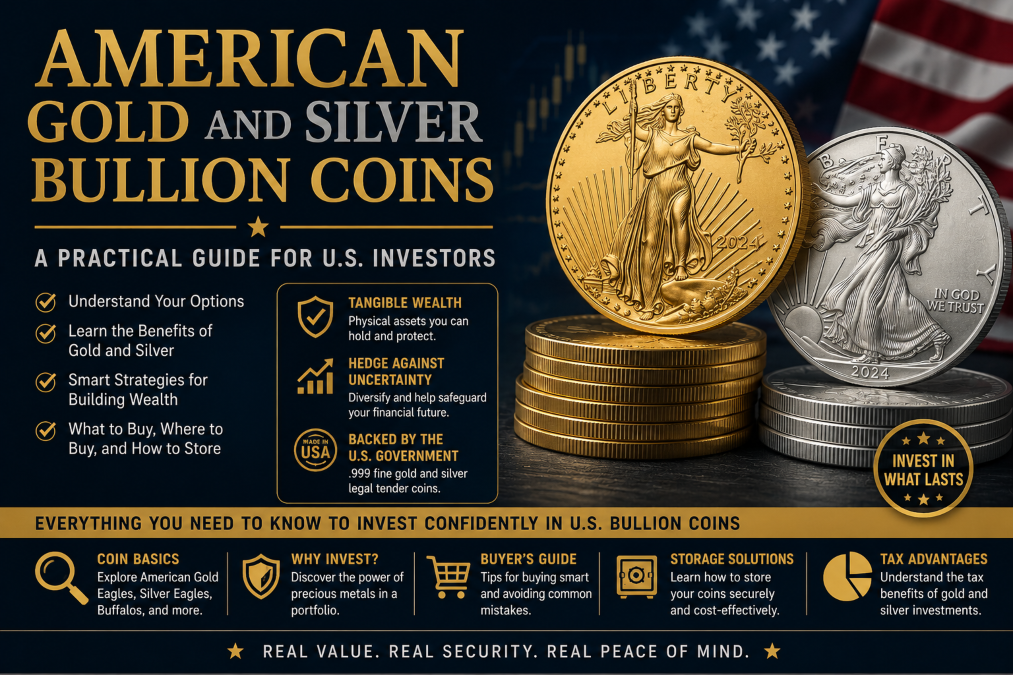
For centuries, precious metals have served as a store of wealth, a hedge against inflation, and a tangible asset that fits in the palm of your hand. In the United States, government-issued bullion coins—particularly American Gold Eagles and American Silver Eagles—have become the most popular way for everyday people to own gold and silver. Unlike rare numismatic coins whose value depends on grade and scarcity, bullion coins derive most of their worth from their metal content. This makes them straightforward, liquid, and accessible to anyone with a few hundred dollars to invest.
Whether you are worried about economic uncertainty, diversifying your retirement portfolio, or simply want to hold something beautiful and valuable, American bullion coins deserve your attention. This guide will walk you through everything you need to know: the types of coins, where to buy them, how to avoid scams, and whether they make sense for your financial goals.
What Are American Bullion Coins?
Bullion coins are minted from precious metals—gold, silver, platinum, or palladium—with a purity and weight guaranteed by the U.S. government. The United States Mint produces four main series for investors:
- American Gold Eagle: First released in 1986. Contains 91.67% gold (22 karats), with small amounts of silver and copper added for durability. Available in 1 ounce, 1/2 ounce, 1/4 ounce, and 1/10 ounce sizes. The design features Augustus Saint-Gaudens’ iconic Walking Liberty on the obverse and a family of eagles on the reverse.
- American Silver Eagle: Also launched in 1986. Contains one full troy ounce of 99.9% pure silver. The obverse uses Adolph A. Weinman’s Walking Liberty design (originally from the half dollar coin), and the reverse features a heraldic eagle. It is the world’s best-selling silver bullion coin.
- American Gold Buffalo: Introduced in 2006. Made of 24-karat (99.99% pure) gold, making it one of the purest gold coins ever produced by the U.S. Mint. The design replicates James Earle Fraser’s Indian Head Buffalo nickel from 1913. Only available in 1 ounce.
- American Platinum Eagle: Also launched in 1997. Contains 99.95% platinum. Produced in smaller numbers and less familiar to casual investors, but highly prized by collectors.
For most first-time buyers, the Silver Eagle and the Gold Eagle are the logical starting points.
Why Invest in Bullion Coins Instead of Bars?
You can buy gold and silver in many forms: bars, rounds, or even jewelry. But U.S. bullion coins offer unique advantages. First, they are legal tender—a Silver Eagle carries a face value of one dollar, and a Gold Eagle has a face value of fifty dollars. Of course, their actual value is far higher, but this official status guarantees authenticity. Second, they are widely recognized and liquid. A dealer in any U.S. city will buy American Eagles on the spot. Third, they are easier to sell in small pieces. A one-ounce gold bar might be difficult to split, but you can sell a tenth-ounce Gold Eagle whenever you need cash.
How to Determine the Value of a Bullion Coin
The price of any bullion coin is based on three factors: the spot price of the metal, the premium, and the condition.
Spot price is the current market price for one troy ounce of gold or silver, set by global commodity exchanges. As of mid-2026, gold trades roughly between $2,300 and $2,500 per ounce, while silver trades between $28 and $35 per ounce. These prices change daily.
Premium is the extra amount a dealer charges above spot to cover minting, distribution, and profit. For a standard Silver Eagle, premiums typically range from $2 to $5 per coin. For a Gold Eagle, premiums are lower percentage-wise—often 3% to 5% above spot—but can be higher for fractional sizes. Proof coins (special collector versions with mirrored finishes) carry much higher premiums but are not recommended for pure bullion investors.
Condition matters only for collectible versions. For bullion investors, a scratched Silver Eagle is still worth its silver weight. Do not pay extra for “brilliant uncirculated” or “first strike” labels unless you are a numismatist.
Where to Buy American Bullion Coins Safely
Reputation is everything in the precious metals market. Here are the most reliable channels for U.S. buyers:
- Local Coin Shops: The best option for beginners. You can inspect the coin, pay cash, and walk out with it immediately. Establish a relationship with a shop that has been in business for at least five years. Ask for references or check online customer reviews.
- Major Online Dealers: Several well-known national dealers have been operating for decades. They publish live pricing and ship insured. However, be aware of shipping delays and signature requirements. Always verify that the dealer is accredited by the Better Business Bureau and has been a member of the Industry Council for Tangible Assets.
- U.S. Mint Directly: You can buy certain bullion coins from the U.S. Mint’s website, but prices are usually higher than secondary market dealers. The Mint sells only to authorized purchasers in bulk; individuals can buy through their network, but you will typically pay a premium.
- Coin Shows: Major cities host coin shows monthly or quarterly. These events bring together dozens of dealers under one roof, allowing you to compare prices. Bring a magnet and a scale to test coins if you are buying from an unknown seller.
Red Flags and Common Scams
Unfortunately, the bullion market attracts fraudsters. Avoid these traps at all costs:
- Television and radio ads offering “limited edition” or “collector’s proof” coins at huge markups. A Silver Eagle sold for $100 on TV might be worth only $35 in silver. These are legal but predatory.
- Home delivery with “free appraisal.” Never give your credit card information over the phone to a stranger selling metals.
- Counterfeit coins. Chinese-made fake Silver Eagles have flooded the market. Always buy from a trusted source. Purchase a rare earth magnet; real silver is non-magnetic, while most fakes use steel cores that stick.
- Storage fees. Some dealers encourage you to leave your coins in their vault for “safety.” Unless you are buying hundreds of thousands of dollars worth, take physical delivery. If you cannot hold it, you do not own it.
Storage and Insurance
Once you own bullion coins, you need to store them securely. A home safe that is bolted to the floor is sufficient for modest holdings. For larger collections, consider a safe deposit box at a bank—but be aware that bank boxes are not insured by the FDIC. You can purchase separate collectibles insurance through a specialty insurer that covers precious metals.
Never store bullion in a garage, attic, or basement where temperature and humidity fluctuate. Coins do not rust, but extreme conditions can cause spotting on silver.
Selling Your Bullion Coins
When it is time to sell, the process is simple. Call three local coin shops and ask for their “bid” price on American Eagles. The bid is what they will pay you, typically a few percentage points below spot. Online dealers also buy, but you must ship the coins at your own risk. For large quantities, auction houses may get you a better price, but they charge commissions.
Should You Invest in Bullion Coins?
Bullion coins are not a get-rich-quick scheme. Over long periods, stocks have historically outperformed gold and silver. However, precious metals serve a different purpose: portfolio insurance. When inflation rises or the stock market falls, gold often holds its value or increases. Many financial advisors recommend allocating 5% to 10% of your investment portfolio to gold and silver as a hedge.
Silver has more industrial use (solar panels, electronics, medical devices) and tends to be more volatile than gold. It offers higher upside potential but also deeper drawdowns.
Final Thoughts: Start Small, Stack Consistently
You do not need to buy a full ounce of gold at once. Many investors begin with one Silver Eagle per month, which costs around $30 to $40. Over time, these coins accumulate into a meaningful stack. Others buy fractional gold coins—tenth-ounce Gold Eagles cost roughly $250 to $300 each, making gold ownership accessible to almost anyone.
The most important rule is this: buy only what you understand, from sources you trust, and hold for the long term. American bullion coins have stood the test of time. They are beautiful, historic, and financially sound. Whether you are preparing for uncertain times or simply want to own a piece of American heritage, a handful of Silver Eagles or a single Gold Buffalo can bring a surprising sense of security. Stack wisely.