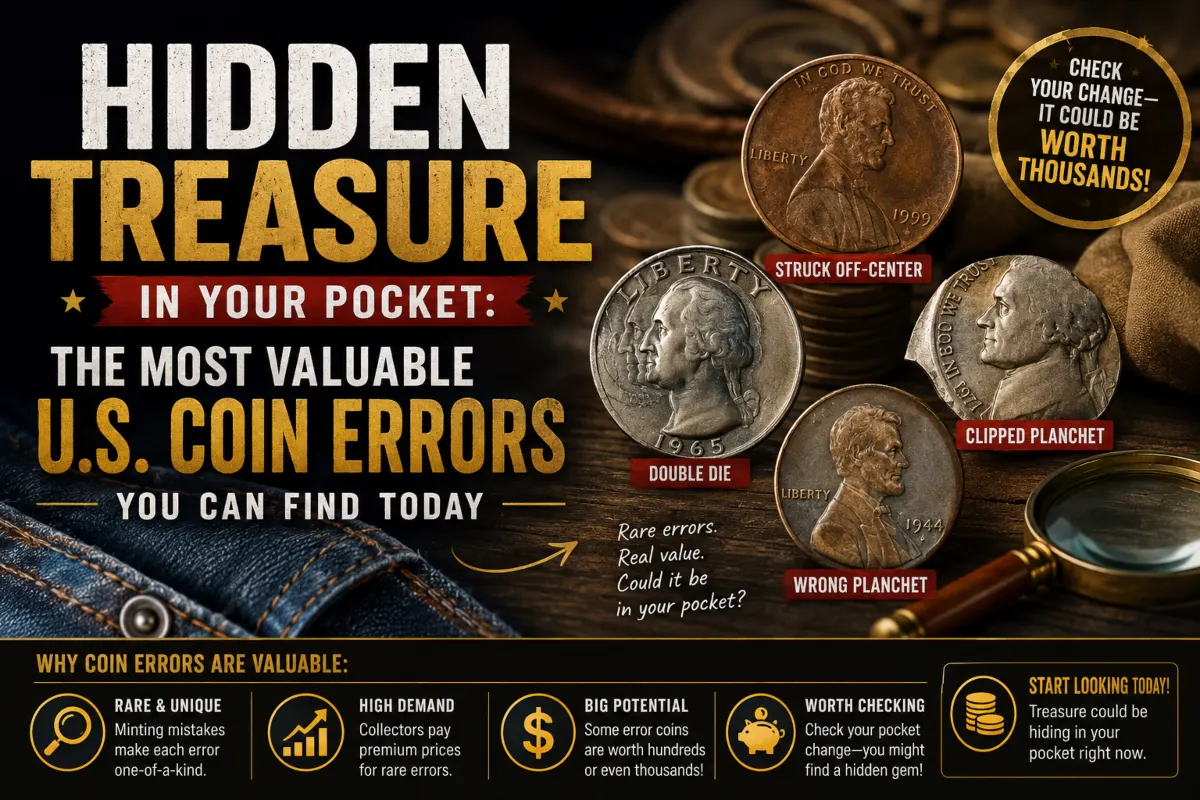
Every day, millions of Americans empty their pockets, toss spare change into jars, and swipe credit cards without a second thought. But hiding in those forgotten coins—the ones under your car seat, in the laundry machine, or at the bottom of an old piggy bank—could be a small fortune. We’re not talking about ancient gold doubloons or rare silver dollars locked in museum vaults. We’re talking about modern U.S. coins with manufacturing mistakes. These mint errors, created by accident at the United States Mint, can turn a humble penny or quarter into a collector’s item worth hundreds or even thousands of dollars.
The best part? You don’t need a metal detector or a dealer’s license. You just need patience, a magnifying glass, and a little bit of knowledge. This guide will walk you through the most common and valuable U.S. coin errors still circulating today.
Why Mint Errors Happen
The United States Mint produces billions of coins each year. With that volume, mistakes are inevitable. A die cracks. A planchet (the blank metal disk) gets fed incorrectly. A coin gets struck twice. These errors slip past quality control inspectors and end up in bank rolls, then into your change. Most are subtle. Some are dramatic. All are legal tender, but their real value comes from scarcity and the fascination collectors have with the minting process.
The Top 10 U.S. Coin Errors to Look For
Here are the most valuable errors that have been found in circulation in recent decades. Check every coin you receive.
1. 1969-S Lincoln Cent Doubled Die Obverse
This is the holy grail of modern error coins. On the obverse (heads side) of a 1969-S Lincoln cent, the lettering and date appear doubled—especially visible in “LIBERTY” and “1969.” The doubling is strong and clear. Only a handful were ever released before the Mint caught the mistake. An authenticated 1969-S doubled die cent in uncirculated condition has sold for over $50,000. Even a worn, heavily circulated example is worth $5,000 to $10,000.
2. 1982 No Mint Mark Roosevelt Dime
In 1982, the Philadelphia Mint accidentally produced a small number of Roosevelt dimes without a mint mark. Normally, Philadelphia coins of that era had no mint mark, but the issue is that these particular dimes were struck using dies intended for the West Point Mint, which would have carried a “P” or no mark? The confusion aside, the genuine error is scarce. A well-preserved 1982 no-mint-mark dime can fetch $300 to $500. One sold at auction for over $1,000.
3. 2004-D Wisconsin State Quarter Extra Leaf
This is one of the most famous modern errors. The Wisconsin state quarter features a cow, a wheel of cheese, and an ear of corn. On some 2004-D quarters, the corn husk has an extra leaf—either a “high leaf” or a “low leaf” variety. The extra leaf is clearly visible to the naked eye. These errors happened when a die was altered by hand at the Denver Mint. Values range from $150 to $300 for circulated examples, and uncirculated versions have sold for over $1,500.
4. 1999 Wide “AM” Reverse Lincoln Cent
Normal Lincoln cents from 1992 to 2008 have the letters “A” and “M” in “AMERICA” nearly touching on the reverse. However, a small number of 1999 cents were struck with a wider spacing, where the “A” and “M” are clearly separated. This error is called the “Wide AM” variety. It is extremely rare for 1999. A 1999 Wide AM cent in average circulated condition is worth $300 to $500. In mint state, it can exceed $1,000.
5. 1972 Lincoln Cent Doubled Die Obverse
While not as dramatic as the 1969-S, the 1972 doubled die cent is still highly collectible. The doubling appears on the date and the words “IN GOD WE TRUST.” There are several varieties, but the most desirable (designated as FS-101) shows strong separation. A raw, circulated example sells for $50 to $150. Slabbed and graded, it can be $300 or more.
6. 1943 Copper Lincoln Cent
This is the king of all error coins, but the odds of finding one are astronomically low. In 1943, the U.S. Mint switched to zinc-coated steel pennies to save copper for World War II ammunition. However, a few copper planchets from 1942 got stuck in the presses. Approximately 20 to 40 copper 1943 cents are known to exist. One sold for $1.7 million in 2010. If you find a 1943 penny that sticks to a magnet, it’s steel. If it doesn’t, have it authenticated immediately.
7. Off-Center Strikes
These occur when a planchet is not properly aligned between the dies. The more off-center, the more valuable. A coin that is 5% to 10% off center might be worth $10 to $20. A coin that is 50% off center with the date fully visible can sell for $100 to $300. Look for half-moon shapes where part of the coin is blank.
8. Broadstrike Errors
A broadstrike happens when the retaining collar (the metal ring that holds the planchet in place) fails. The coin spreads outward, becoming wider and thinner than normal, with no rim. Broadstrike coins can be dramatic and visually striking. A broadstrike quarter might be worth $50 to $150 depending on how well-centered it is.
9. Die Cracks and Cuds
As coin dies age, they can develop cracks. When a crack reaches the rim, it creates a raised, blob-like area called a cud. Minor die cracks add little value—maybe $5 to $10. But large cuds, especially those that obscure part of the design, can be worth $100 or more. The 1995 Lincoln cent with a die crack through Lincoln’s head is a popular variety.
10. Clip Errors
A clipped planchet occurs when the metal strip feeding into the blanking press gets misaligned, cutting a crescent-shaped chunk out of the coin. Clips can be curved, elliptical, or ragged. A genuine curved clip will show a corresponding “Blakesley effect” (weakness opposite the clip). A genuine clip coin can be worth $25 to $200, with larger clips commanding higher premiums.
How to Search for Error Coins
You don’t need special equipment to start. A good magnifying glass or a 10x loupe costs about $10 online or at a hobby store. Here is a simple routine:
First, go to your local bank and ask for rolls of coins—pennies, dimes, and quarters. Many banks will sell you $25 in penny rolls without a fee. Second, spread the coins out under good light. Third, look for obvious anomalies: weird spacing, extra lines, off-center strikes, or missing mint marks. Fourth, separate anything suspicious and research it using printed reference books or official mint error guides available at public libraries. Never clean a potential error coin; let a professional dealer or third-party grading service evaluate it.
What Not to Waste Time On
Not every odd-looking coin is valuable. Post-mint damage—like coins that have been ground, drilled, or smashed by machinery—is worthless to collectors. Also, “grease-filled die” errors (where parts of the design are missing due to grease clogging the die) are common and rarely worth more than $5 to $10 unless the missing area is dramatic.
The Thrill of the Hunt
The beauty of searching for mint errors is that it costs nothing but time. Every roll of coins is a lottery ticket. Thousands of people have found four-figure error coins in their pocket change. A truck driver in Ohio found a 1974 aluminum cent (worth $200,000). A teenager in Massachusetts discovered a 1999 Wide AM cent in a roll from her school cafeteria. You could be next.
Start today. Look at the coins in your wallet right now. Check the 2021 quarters for die cracks. Examine your 2017 pennies for doubling. Train your eye, and you will start seeing errors everywhere. The coins are out there, waiting to be found. Happy hunting.